Catégorie : Self-help
When you enter a new field, we can usually be sure of a few things:
1: You’re not nearly as good or as important as you think you are.
2: You have an attitude that needs to be readjusted.
3: Most of what you think you know, or most of what you learned in books or in school, is cout of date or wrong.
Ryan Holiday
OPDCA Method
Observe, Plan, Do, Check, Adjust
‘RASA’ — Receive, Appreciate, Summarise and Ask.
Conversation technique by Julian Treasure.
Ask & listen.
The level of your emotional frequency provides a score, 20-1,000.
- Shame (20 points)
- Guilt (30 points)
- Apathy (50 points)
- Grief (75 points)
- Fear (100 points)
- Desire (125 points)
- Anger (150 points)
- Pride (175 points)
- Courage (200 points)
- Trust (250 points)
- Optimism (310 points)
- Forgiveness (350 points)
- Understanding (400 points)
- Love (500 points)
- Gratitude (510 points)
- Joy (540 points)
- Peace (600 points)
- Enlightenment (700-1,000 points)
Benjamin P. Hardy
HiPPO rule decision
Modal bias : HiPPO rules—decisions are made according to the “Highest Paid Person’s Opinion.” HiPPO is a term coined by Avinash Kaushik.
The 4 categories of activities
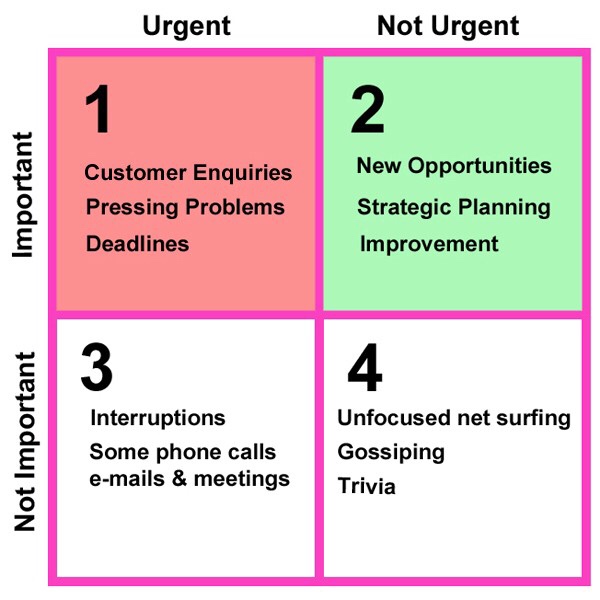
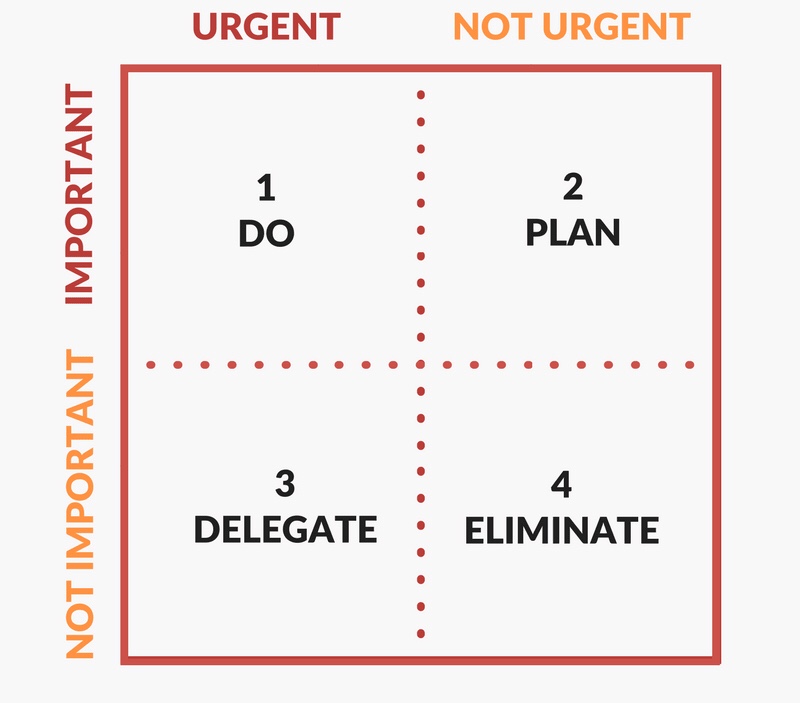
Dr. Stephen Covey – The 7 Habits of Highly Effective People
Who could you collaborate with to take this 10X or 100X bigger?
Benjamin P. Hardy
I can do anything but not everything.
Clarify the question. “What question are you trying to answer?”
McKeown – Essentialism
If you stick with a behavior for approximately eighteen months, you will build a strong tendency to stick to it nearly forever.
Ray Dalio – Principles
Act, reflect. Act, reflect. NEVER act and reflect at the same time.
Steven Pressfield – Do the work
The problem with friends and family is that they know us as we are. They are invested in maintaining us as we are. The last thing we want is to remain as we are.
Steven Pressfield – Do the work
You already know all that you need to succeed. You don’t need to learn anything more. If all we needed was more information, everyone with an Internet connection would live in a mansion, have abs of steel, and be blissfully happy.
Darren Hardy
Think of what you want your life to be like and then find a job or create one that meets your criteria.
Richie Norton
Is this the very most important thing I should be doing with my time and resources right now?
Essentialism: The Disciplined Pursuit of Less.
Make today an action for tomorrow
Fondamentaux
Essayer d’extraire dans chaque sujet les fondamentaux et les invariants.
Penser en systèmes et interconnexions.
Questions
1. Am I happy?
2. Am I grateful?
3. Do I like my job?
4. Do I feel good?
5. Do I spend enough time on my education?
6. What new things am I learning?
7. Where is my career going?
8. How meaningful is my work?
9. What can I do that I’m currently not doing?
10. How can I get better at what I do?
11. What is the biggest pain point that our clients/customers have?
12. What is the ideal solution in the eyes of our clients/customers?
13. How can we give away more value without charging more?
14. Where can we reach our potential clients/customers?
15. How can we decrease our costs?
16. What’s my #1 priority right now?
17. How can I achieve my #1 priority faster?
18. What tasks should I stop doing?
19. What tasks am I procrastinating?
20. What questions am I not asking myself?
21. How can I help one person today?
Eurêka !
The four stage of creativity by Graham Wallas :
1 – Preparation
2 – Incubation
3 – Illumination
4 – Verification
Conversation : The Three Postures
Master, student or peer.
The key is to be able to go into peer posture with anyone. The young intern, the big boss, the politician, the cleaner. Anyone. Better: being able to go into “master” with people with more social status or a higher hierarchical position, and into “student” with people with less social status or a lower hierarchical position.